

Introducing the project COBASI Project of the National Research Programme NRP 81
In many rural municipalities, services of general interest are changing noticeably. Post offices are closing, village shops are struggling to survive, bank branches are disappearing, and it is becoming increasingly more difficult to secure long-term medical care. At the same time, there are buildings in village centres that used to serve precisely these functions: former post offices, inns, small shops, community centres, and railway stations. These buildings are often centrally located, easily accessible and continue to shape the character of the place. Yet when services disappear or change fundamentally, these buildings lose their original purpose. This results in vacancies or conversions that no longer serve as services of general interest (SGI). And yet there is still a clear need for physical places that bring essential services together, enable encounters and function as everyday meeting points. COBASI understands these places as key anchors of basic services and social life in rural municipalities.
Baukultur: Shaping the Quality of Our Built Environment
Baukultur means all human activities that shape the built environment. It includes landscapes, buildings, infrastructure, public spaces, and even the spaces in between. The whole living environment is seen as one connected system. It covers both old and new structures, including historic sites and modern buildings. Baukultur also focuses on how things are planned and built — from design competitions and public participation to the actual construction. In short, Baukultur is about the quality of how we design, build, and manage our entire living environment.
For example Baukultur refers Baukultur to the interplay of buildings, streets and public spaces in shaping the built environment. Especially in rural areas, places providing basic services often play a key role in forming local identity. They are part of a village’s history and serve as points of orientation in everyday life. Baukultur quality emerges from the interplay of building, public space and use. The decisive question is whether a site contributes to basic services, strengthens the village centre and functions as a place for daily life and social interaction – not merely how it looks.
COBASI builds on this expanded understanding of Baukultur, as anchored in the Davos Declaration adopted by the Swiss Confederation.
Need for Action and Exchange of Experiences
The demands placed on municipalities and property owners are increasing: legal requirements, economic constraints, building regulations or heritage protection make conversions complex. At the same time, operating and business models are changing, and digital services are gaining importance. In this field of tension, solutions are needed to assure both a transformation of the building and its program, that should answer to specific and local needs. The COBASI project therefore, explicitly addresses questions of governance: who decides what, using which instruments, and through what forms of cooperation between public authorities, private owners, service providers and civil society in order to process to rural revitalization.
COBASI links Baukultur and services of general interest in rural municipalities. It aims to show how existing buildings and central places can be further developed so that village centres remain attractive, functional and vibrant in the long term.
Building a Network of Practioners
COBASI combines analytical research with practice engagement. The project collects and analyses good examples from rural municipalities in Switzerland and across Europe where processes of village revitalization have occured. By examining the relationship between Baukultur and the integration of Services of General Interest (SGI), this comparative work identifies key levers for successful transformation processes in rural contexts.
At the same time, the project establishes a network of municipalities and professionals who are directly involved in such transformation processes.
Engaging Co-creation Pprocesses
Through a Call for Projects, selected municipalities participate in a structured co-creation process. The insights gained from the analytical work are further developed together with local actors in workshops, allowing concrete and implementable next steps to emerge.
These co-creation processes are deliberately interdisciplinary, involving planners, policymakers, property owners, service operators and members of the local community. The aim is to translate research findings into context-specific strategies for strengthening village centres.
In the end, transferable insights and practical recommendations are produced for municipalities and practitioners . These results will be translated into policy recommendations, shared and discusses through a travelling exhibition, and contribute to fthe establishment of a network of municipalities and professionals.
The project is funded by the National Research Programme NRP 81 “Baukultur – for an ecological and social transition of the built environment” and combines scientific analysis with concrete implementation.
------------------------
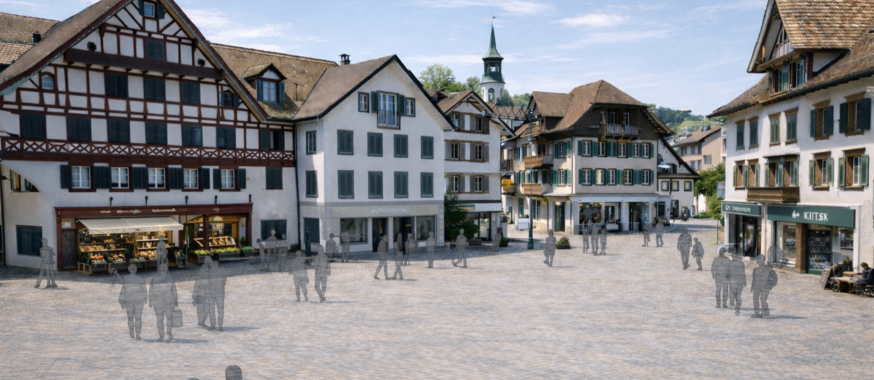
visualization generated with AI