

Call for Projects – We Support Bold Projects!
This call aims to support concrete, locally anchored projects that integrate services of general interest (SGI) and Baukultur in a specific building or central site within a rural municipality. Eligible applicants include mayors, municipal authorities, property owners, and service providers.
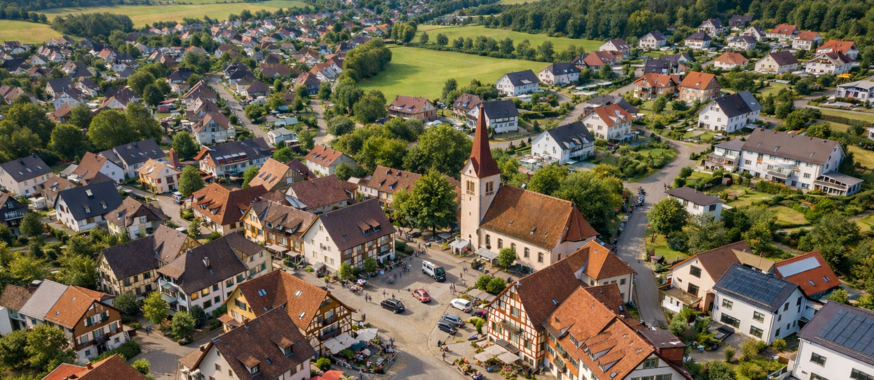
In rural communities, places of services of general interest are often more than just functional locations. They are identity-forming anchors in the community structure, offering venues for social encounters in the everyday life of villagers: spatially recognizable by their central locations (village centers, squares, important road axes) and materially represented by buildings or architecture, often historic, which function as place markers and expressions of identity.
This structure is under increasing pressure. Demand and operating models for public services are undergoing fundamental changes. Physical contact points such as branches, counters, or meeting places are losing importance, while digital offerings are becoming more important. At the same time, requirements and requirements in terms of building and monument protection are increasing. As a result, many buildings and locations are losing their original function, even though they remain centrally located and retain their potential as meeting places and identity-forming centers. Numerous buildings that were formerly used for public purposes now stand empty, including post offices, town halls, inns, grocery stores, and doctors' offices. With this call for proposals, we are specifically looking for examples that address this situation: vacant or unused buildings in central locations that have the potential to house renewed or combined types of public services.
The COBASI project, funded by the Swiss National Fund, addresses this topic by exploring the integration of building culture and services of general interest in rural areas. The aim is to derive implementable strategies and approaches for projects, as well as to reflect on overarching framework conditions and identify necessary actions. The central principle is a co-creation approach that brings together operators, politicians, administrators, businesses, and civil society to jointly develop and test solutions in the local context. Selected projects will receive structured methodological support and expert facilitation to develop a concrete and realistic implementation roadmap.
Which projects are supported?
Our aim of the co-creation processes is to reconnect high-quality Baukultur with the current needs of services of general interest. Through our process of support, we intend to support three concrete projects in building this bridge. Projects can start from different situations. Whether there may be a vacant building that could be reused, or there may be a lack of services of general interest, or there is the risk that such services will be lost. Projects may be at an early conceptual stage or already in preparation. However, a minimum level of political and ownership commitment is required at the time of application. We support initiatives facing these challenges by guiding them through a structured co-creation process.
By applying, you confirm that key decision-makers (e.g., mayor, municipal administration, property owner, service provider) are willing to participate actively in the full co-creation process and to explore concrete implementation steps. However, the successful implementation of the project is not a mandatory requirement within this application.
What can you expect in terms of support?
The selected projects receive structured process support from the COBASI team and other experts. The process is designed as a co-creation and aims to find a sustainable, implementation-oriented solution that strikes a resilient balance between the requirements of service operators, the architectural qualities of the location, the municipal development perspective, and legal and economic realities successfully combined to the benefit of the local population.
In addition, the selected projects gain national visibility as part of NFP 81, and municipalities and service providers position themselves as partners with a strong capacity for learning and implementation, demonstrating the attractiveness of their location and their agility in dealing with services of general interest. The Call does not provide financial subsidies for construction or investment. The support consists exclusively of expert facilitation, methodological guidance, and integration into a national network. As selected project, you will have the opportunity to feed overarching framework conditions and hurdles arising from legislation, funding, standards, or enforcement into the dialogue with expert circles and political actors.
How we envision the co-creation process
In the initial phase, the relevant actors are identified, additional actors are invited, the understanding of the problem is jointly sharpened, and reference projects are discussed. This is followed by a central, full-day co-creation workshop on site, in which the core of the problem, the target vision, and solution options are systematically developed and weighed against each other. In a subsequent process step, the workshop results are translated into concrete project routines, with clear next steps, responsibilities, clarification tasks, and a roadmap for implementation.
The methodological framework (design thinking) serves to structure decision-making and does not require prior methodological knowledge from applicants.
How to apply
We are looking for projects or project ideas in rural municipalities that aim to engage in a process of revitalization through the integration of services of general interest and Baukultur to transform vacant or underused existing buildings, integrating some form of services of general interest.
The scope of the project may relate to various services of general interest (e.g., local supply, postal/communication, mobility/public transport, health/social services, education/care, culture/social interaction, affordable housing for different age groups and lifestyles). Projects may focus on one specific service or combine several services in a multifunctional approach. Both single-service and multi-service concepts are eligible.
We are looking for projects or project ideas that aim to develop joint solutions of services of general interest and Baukultur. Key stakeholders in this process are municipalities, service providers, landowners, and stakeholders taking responsibility to get the project done. Applications can be submitted by at least two stakeholders, like municipalities, public-private partnerships, private property owners, or service providers, expressing their intention for cooperation by a letter of intent.
Selection criteria include relevance to the integration of Baukultur and services of general interest, feasibility, stakeholder commitment, and transfer potential to other rural municipalities.
Submission on this website in French or German.
Effort and commitment
Your time commitment includes proactive participation in the co-creation process. This includes the kick-off meeting, the full-day co-creation workshop, and a meeting on the implementation process/roadmap, as well as accompanying clarifications with other stakeholders.
The applicants are responsible for rooms and catering as part of the co-creation process. Travel costs and internal working hours must be covered by the participating project partners. Furthermore, participation in the COBASI interim event (24 June 2026) and the final event (early 2027) is expected.
While implementation is not a formal obligation, applicants should demonstrate a serious intention and realistic perspective to move towards implementation.
Schedule and Contact
- Launch of call for projects: March 2, 2026
- Online Q&A sessions: March 27, 2026, 9-11 a.m. and April 23, 2026, 1-3 p.m.
- Application deadline (new): May 15, 2026, 12:00
- Decision: June 1, 2026
- Communication of results: June 3, 2026
- Presentation of selected projects: June 24, 2026 (COBASI mid-term event)
- Co-creation workshops in August/September 2026, October/November 2026, and April/May 2027
For further requests, please contact Mirjam Iselin in German mirjam.iselin(at)ost.ch or Julie Rionde in French julie.riondel(at)hefr.ch
------------------------
visualization generated with AI