

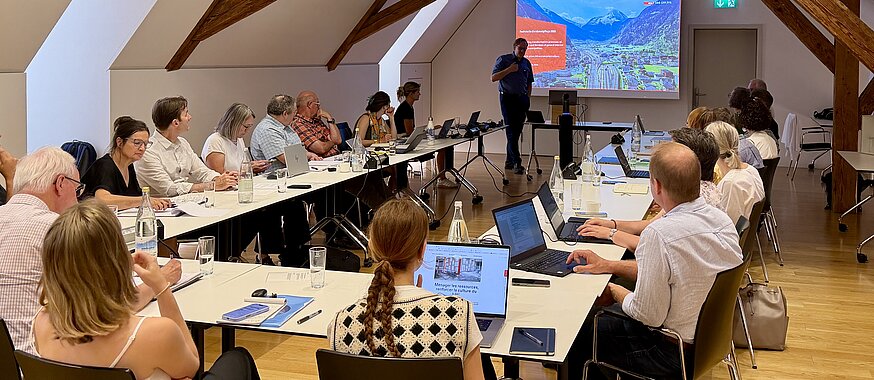
Thinking About Building Culture and Services of General Interests – Insights from the COBASI Midterm Event
How can village centers remain vibrant? This question is at the heart of the event “Building Culture & Services of General Interests– Reimagining Best Practices, Launching Projects, Building Networks,” taking place on June 24, 2026, at the Berner Generationenhaus. Representatives from municipalities, infrastructure companies, planning, politics, and research will come together to discuss how spatial quality, public services, and local engagement must interact to make rural communities sustainable for the future.
The event vividly demonstrates that building culture is far more than just architecture. It describes the way in which buildings, public spaces, infrastructure, and land uses collectively create quality of life and support social development.
Building culture starts with people
Mathias Müller, mayor of Lichtensteig, will kick off the event. Using the development of the Wakker Prize-winning community as an example, he will demonstrate that attractive historic buildings alone do not create vibrant town centers. Only a long-term strategy, consistent community involvement, and a willingness to rethink existing buildings can bring about sustainable change.
Lichtensteig views vacant properties not as a sign of decline, but as potential for development. Former administrative, industrial, and post office buildings are gradually being repurposed—from coworking spaces to cultural venues to public services. Crucial to this process is the municipality’s shift in role: away from mere administration and toward facilitation. Participation is not viewed as a one-off workshop, but as an ongoing commitment.
Infrastructure as Part of Local Development
Reto Bieli of SBB complements this municipal perspective with the viewpoint of an infrastructure operator. Train stations, along with their buildings and public spaces, are symbols of identity and often among the most important locations for providing basic services.
Particularly impressive is his expansion of the traditional economic analysis. In addition to the business-oriented return on investment, there needs to be a “village return”: the long-term added value for a community through attractive public spaces, good accessibility, and vibrant centers. These qualities do not arise automatically through market forces but require coordination among many stakeholders as well as a shared understanding of building culture as an integrated spatial system. Examples from Erstfeld, Güttingen, and Ambri-Piotta demonstrate how historic train station buildings can continue to play an important role in meeting local basic needs through new uses.
Research Reveals Common Success Factors
The subsequent presentations by the research groups bring together the findings from two different perspectives.
An analysis of over 30 international best-practice examples from five countries clearly shows that successful projects rarely rely on standardized solutions. Instead, they result in site-specific combinations of preservation, repurposing, additions, or selective new construction.
It is particularly striking that almost all successful projects combine multiple functions. Essential services, culture, social interaction, education, and work often take place under one roof.
A key spatial pattern is the creation of spacious, flexible communal areas. About two-thirds of the projects studied feature multipurpose rooms or similar communal spaces. Equally important is the combination of different uses within existing buildings. In this context, building culture does not mean merely preserving historic structures, but rather adapting them to meet today’s needs.
Good Governance Is Key to Success
Complementing the spatial perspective, a governance analysis of selected Swiss case studies reveals the organizational and institutional prerequisites required for successful projects.
The interplay of various factors is crucial. In the interviews conducted for the governance analysis, respondents frequently cited dedicated “champions” and advocates, supportive municipal authorities, participatory processes, transparent communication, a balance between historic preservation and functionality, the combination of different uses, and strong social cohesion.
The challenges are equally clear: financing, conflicting goals between preservation and use, a lack of human resources, and insufficient involvement of future users complicate many projects. From this, the research team draws a key conclusion: built culture and services of general interestsreinforce one another—provided that good governance creates sustainable organizational and financial solutions.
From Research to Implementation
A key milestone of the event is the transition from analysis to action. From the calls for proposals conducted throughout Switzerland, two municipalities have been selected; the COBASI team will now support them through a co-creation process, applying the knowledge gained to assist them.
In Büron (LU), the historic Braui is the focal point. Together with residents, the municipality, and other stakeholders, new uses will be developed to strengthen basic services, community interaction, and identity in the village center.
In the Schwende-Rüte district (AI), the train station and adjacent areas are being developed into a new village center. The project aims in particular to strengthen public space as a connecting element between mobility, built environment, and basic services.
The guided co-creation process combines scientific findings with the experiences of local stakeholders. The goal is not to develop a one-size-fits-all solution, but rather transferable methods and processes that other communities can also use.
A Network for the Period Following the Research Project
To ensure that the findings do not end with the project’s conclusion, the COBASI Practice Network will be established halfway through the project. The network will bring together municipalities, infrastructure operators, planning firms, researchers, and other practitioners on a long-term basis. At its core are regular on-site visits, during which successful projects are analyzed together and experiences are shared. In this way, knowledge is not only documented but also continuously refined and immediately fed back into practice.
Would you like to be part of the Baukultur and Primary Care Practice Network? Sign up for the newsletter.